> whoami
Steven Burns
AI is the instrument. Creativity is the fuel. Twenty-five years at the edges of technology decide what gets played.
I’m Steven Burns. makerATL is the name I build under, out of Atlanta.
I’ve always worked at the edge of what the tools could do. In the early web that meant an on-demand movie service in 2003, years before streaming had a name, then HTML5 animation when Flash still ruled and a JavaScript green screen for photo booths. In experiential marketing it meant mobile escape rooms, a Final Four basketball simulation and custom sensor boards, with a team I built to make them.
AI is the newest edge, and I explore it the same way: lots of divergent experiments, most of them small, a few of them the start of something bigger. AI News Brew began as a handful of Python tools; the Timberborn map tools began as curiosity about a file format. The experience is what tells me which experiments to keep.
By day that means AI products and agent tooling. After hours, the same curiosity goes into games, generative media and light installations around the house.
Atlanta, GA · Open to conversations about what’s next
Looking for the traditional CV, with career history and a PDF? It’s at stevenburns.net ↗.
What I do
Exploration and prototyping
Fast, cheap experiments at the edge of what a new tool can do, so the promising directions show up early and the dead ends cost almost nothing. It’s how I’ve worked since the early web.
AI products, end to end
I decide where a model earns its place in a real app, then build everything around it: prompt caching, tool gating, benchmarks and cost controls, plus the auth, payments and offline support a product needs.
Agents and tool ecosystems
I write the MCP servers and tooling that let agents act on devices, media and data, and I put a confirmation step wherever an action reaches the outside world.
Local-first generative pipelines
I orchestrate ComfyUI, Ollama and my own tooling for image, video, voice and music on my own GPUs, sequencing heavy models so one workstation runs them all: repeatable, scriptable and cheap.
Interactive and physical
3D on the web, games and LED installations. Years of building live events taught me that the part people touch is the part that has to work.
How I work
- 01Explore first: my best directions started as experiments nobody asked for.
- 02Understand why something is the way it is before changing it.
- 03Ship the smallest real thing, then iterate against actual use.
- 04Give each model one clear job; keep the rules that must hold in plain code.
- 05Stay the one who decides: I approve the work before it ships, whoever or whatever drafted it.
- 06Leave systems documented, tested, and easier for the next person.
Maker history
Streaming movies in 2003, escape rooms, light installs and now local AI: twenty-five years of building things to find out what a new technology can do. More on YouTube ↗.
2003
Streaming movies before it had a name
Cre8ive Media, an on-demand movie service I built when online streaming was barely a concept: a digitized film library, tie-ins with Joost, Crackle and Pandora, films rescored with new music, and a phone as the remote. Netflix and Hulu won the market; the lessons fed everything after.
2005–13
Pushing the early web
A WYSIWYG email builder that sent hundreds of thousands of emails, a JavaScript green-screen filter for photo booths, HTML5 animation on phones while Flash still ruled the web, and multi-screen fan experiences over web sockets.
2017–18
Escape-room tech for brand activations
Interactive technology for brand-awareness escape rooms, built and shown with partners.
2018
IoT lamp from a vintage snowspeeder
A vintage-store Star Wars snowspeeder retrofitted with LEDs, launched with an original parody video.
2020
Light Beats on the garage
Six hundred LEDs across the garage-door windows, synced to music.
2021
Building a dual-extruder 3D printer
Assembling and tuning a Weedo X40 IDEX printer, with the tips I picked up along the way.
2022
Sculpting in VR
A Mandalorian helmet built piece by piece in Gravity Sketch, learning sub-D modelling in a headset.
2022
Project White Stork
Zel, my first original 3D-modelled character, made as a way to give to Ukraine.
2023
AI News Brew goes public
An interview about the AI News Brew platform and how it changes the way news is read.
2023
What a persona does to an answer
I pitched GPT-4 an old joke idea, powering the world with wagging dog tails, under different personas: friendly, critical, cynical, snarky, mathematical, energy expert. The friendly assistant called it promising; the cynical, mathematical and energy-expert versions took it apart. The role you give a model is part of the program.
2023
One character, many styles
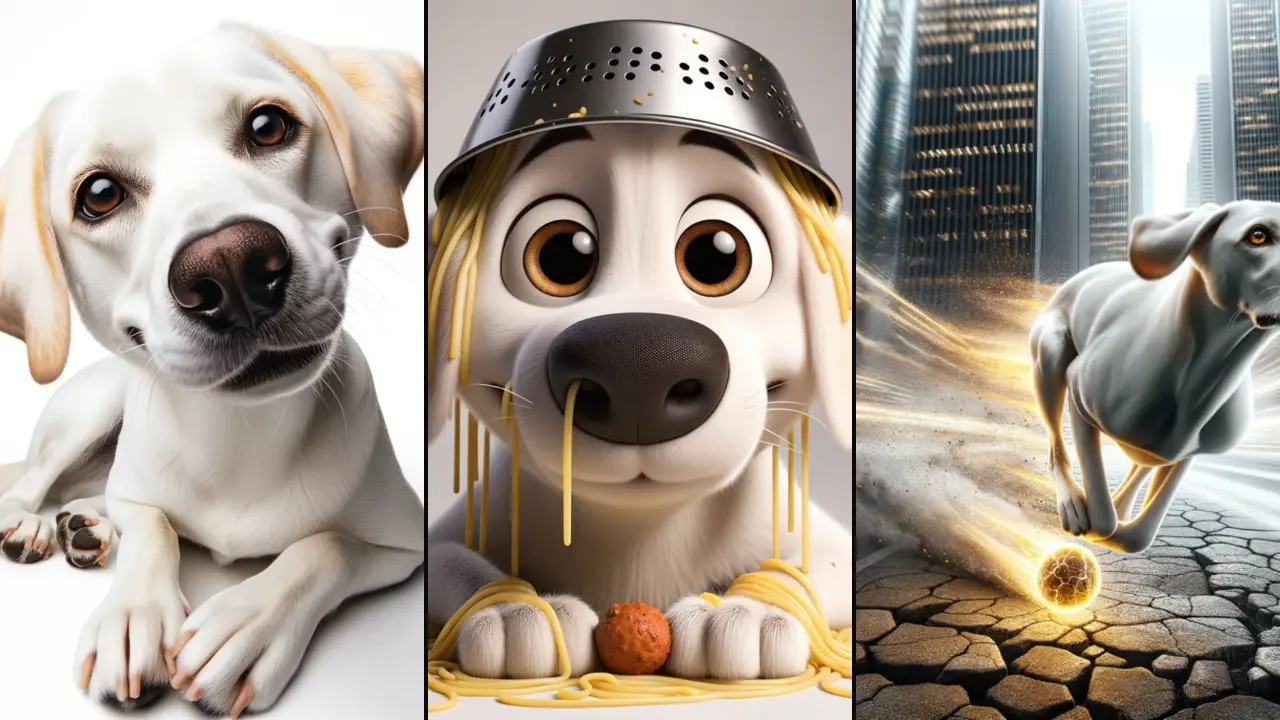
Early DALL·E 3 experiments in keeping Watson, a white Labrador-hound mix, recognisable across a studio photo, a 3D cartoon and an action shot. Holding a character steady is still the problem I work on in image pipelines today.
2024
Local models, local images
LM Studio driving Stable Diffusion on my own hardware, no rate limits or refusals in the loop.
2024
An art car, from sketch to concept
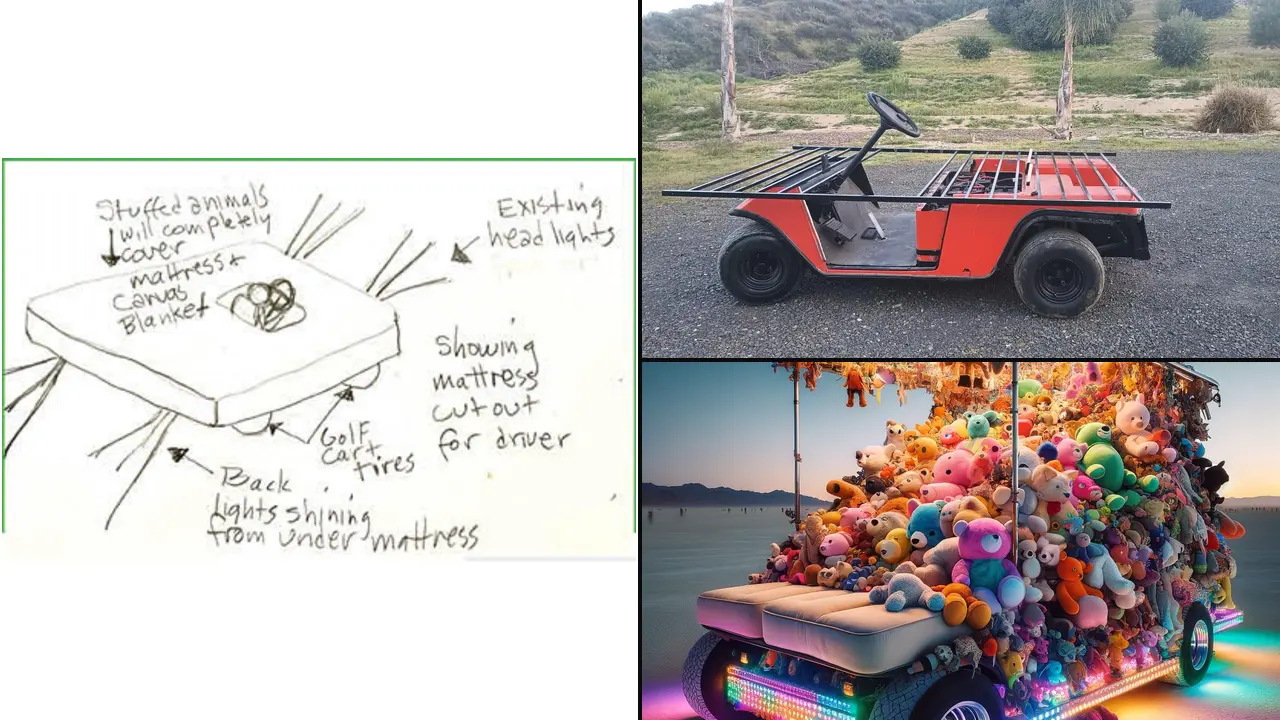
A Burning Man art car on a roofless golf cart: a king-size mattress bed, stuffed animals along the sides, lights under the frame. Starting from a hand sketch and a photo of the real cart, DALL·E 3 and Midjourney turned it into concept renders to build from.
2024
LLMs drawing in code
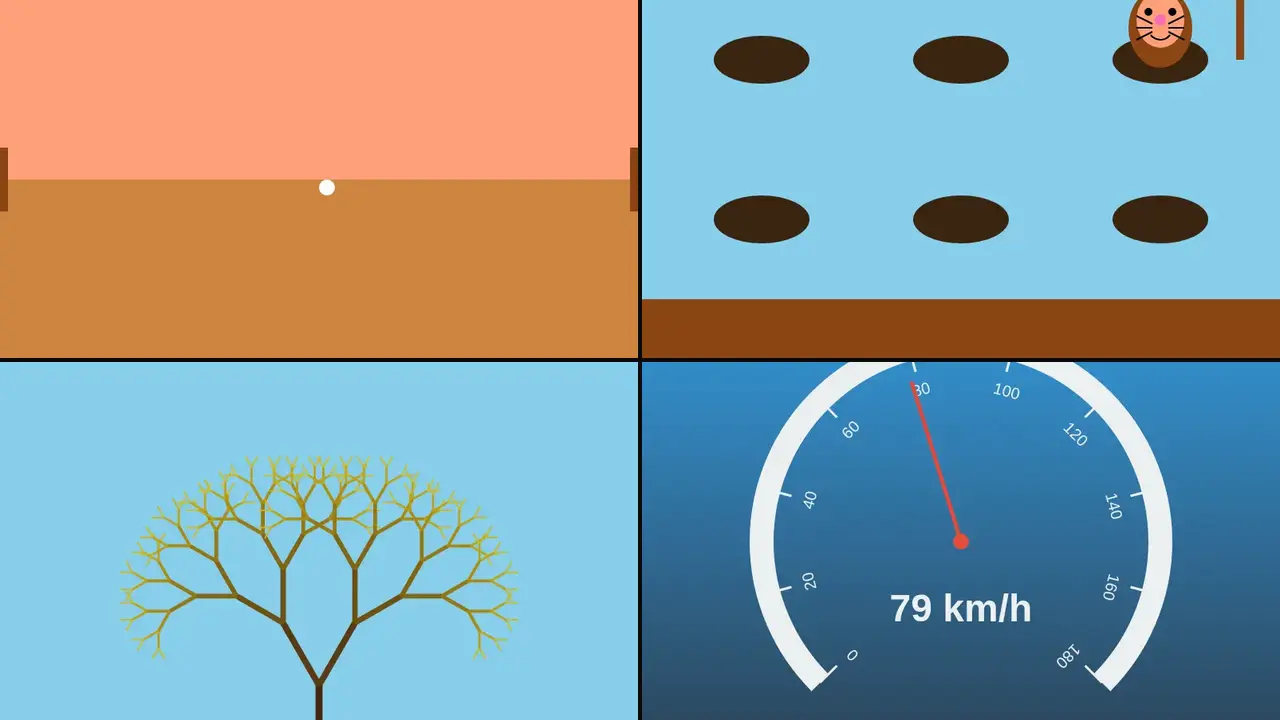
A run of one-line prompts asking language models to write HTML canvas animations and small games, from a waving stick figure to pong at sunset, whack-a-mole and a fractal tree. A snapshot of what the models could draw in code at the time.
2024
Sephira and the music videos
Sephira, an AI character whose story unfolds across a series of AI-animated music videos.
2024
The SubSymph ComfyUI workflow
A published ComfyUI animation workflow, distilled from many hours of testing approaches.
2026
Lull →
A sleep app for my wife after Calm lost her prepaid year: designed, built and shipped in a morning.